Pearson Edexcel · GCSE · Music
Course version: 1MU0 · Version from Sept 2016
Musical vocabulary - Dynamics and performance matters: A guitar technique:…
Full specification wording
Appendix 3: Musical vocabulary - Dynamics and performance matters: A guitar technique: a string is plucked by ‘pulling’ the string off the fingerboard with a finger used to fret the note
This vocabulary item names a guitar articulation in which the player does not use the picking hand to sound the note.
- Point 13 of 25
- 3 key terms
Study notes
From the teaching notes for this specification point.
The idea
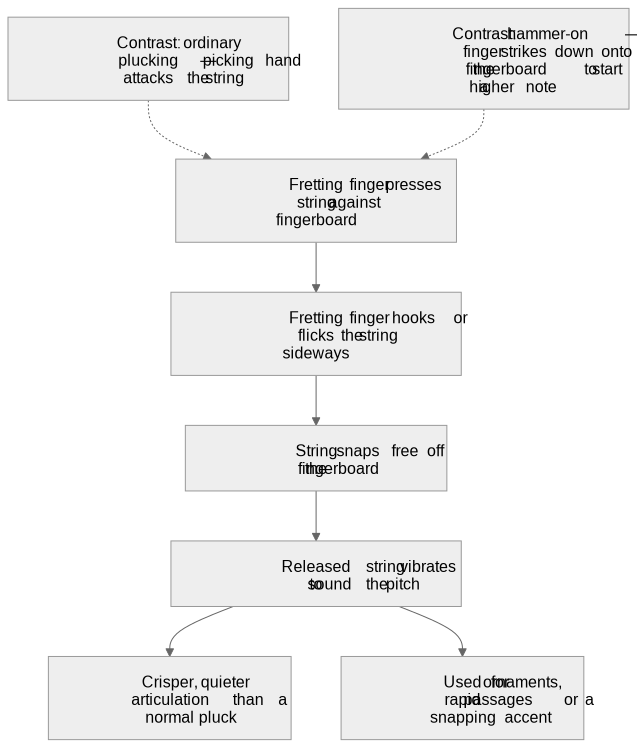
This vocabulary item names a guitar articulation in which the player does not use the picking hand to sound the note. Instead, a finger already pressing a string against the fingerboard hooks or flicks that string sideways so it snaps free, and the released string vibrates to produce the pitch. Because the fretting finger itself sets the string moving, the sound is typically crisper and quieter than a normally plucked note, and it lets the player add rapid ornaments or a snapping accent without moving the picking hand. Recognise the defining feature: the string is pulled off the fingerboard by a fretting finger. Contrast it with ordinary plucking, where the other hand attacks the string, and with hammering on, where a finger strikes down onto the fingerboard to start a higher note.
What earns the marks
- Identifies the technique as a pull-off, in which a fretting finger pulls the string off the fingerboard to sound it.
- States that the string is set vibrating by the fretting finger rather than by the picking hand.
- Recognises that the released string sounds the pitch, producing a lighter or snappier articulation than a normal pluck.
- Distinguishes a pull-off from hammering on, where a finger strikes down onto the fingerboard to start a note.
- Links the technique to practical uses such as ornaments, rapid passages or accenting a note.
Common mistakes and how to put them right
Confusing a pull-off with a hammer-on: a hammer-on starts a note by a finger striking down onto the fingerboard, whereas a pull-off releases a fretted string sideways so it sounds.
Assuming the picking hand plucks the string.
Put it right: In a pull-off the fretting finger itself sets the string vibrating.
Thinking the technique raises the pitch.
Put it right: A pull-off normally sounds a note at or below the fretted pitch as the finger leaves the string, not a higher one.
Exam tips
- Anchor the answer on the key action: a fretting finger pulls the string off the fingerboard.
- Use the contrast pair pull-off versus hammer-on to eliminate wrong options quickly.
- Check whether an option describes the picking hand; if it does, it is unlikely to be a pull-off.
Try the lesson
The start of the Appendix 3: Musical vocabulary - Dynamics and performance matters: A guitar technique: a string is plucked by ‘pulling’ the string off the fingerboard with a finger used to fret the note lesson, made from teaching notes for this specification point.
Have a go first
Which guitar technique involves plucking a string by pulling it off the fingerboard with a finger that is already fretting the note?
Listen
This vocabulary item names a guitar articulation in which the player does not use the picking hand to sound the note. Instead, a finger already pressing a string against the fingerboard hooks or flicks that string sideways so it snaps free, and the released string vibrates to produce the pitch. Because the fretting finger itself sets the string moving, the sound is typically crisper and quieter than a normally plucked note, and it lets the player add rapid ornaments or a snapping accent without moving the picking hand. Recognise the defining feature: the string is pulled off the fingerboard by a fretting finger. Contrast it with ordinary plucking, where the other hand attacks the string, and with hammering on, where a finger strikes down onto the fingerboard to start a higher note. A strong answer earns marks for these points. Identifies the technique as a pull-off, in which a fretting finger pulls the string off the fingerboard to sound it. States that the string is set vibrating by the fretting finger rather than by the picking hand. Recognises that the released string sounds the pitch, producing a lighter or snappier articulation than a normal pluck. Distinguishes a pull-off from hammering on, where a finger strikes down onto the fingerboard to start a note. Exam tip: Anchor the answer on the key action: a fretting finger pulls the string off the fingerboard.
See it
Key words
Say what each word means before you turn the card.
Pull-off
Try answering aloud or in your head before turning the card.
Hammer-on
Try answering aloud or in your head before turning the card.
Role of the fretting hand in sound production
Try answering aloud or in your head before turning the card.
See every definition
- Pull-off
- A guitar articulation in which a fretting finger pulls the string off the fingerboard so the released string vibrates to sound the pitch.
- Hammer-on
- A technique where a finger strikes down onto the fingerboard to start a higher note.
- Role of the fretting hand in sound production
- The fretting finger itself sets the string vibrating, rather than the picking hand attacking the string.
Label the diagram
Some boxes have lost their names. Pick the right name for each number.
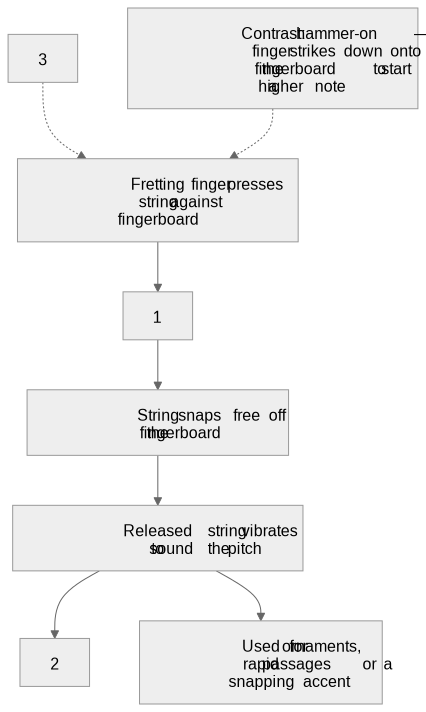
1Box 1
2Box 2
3Box 3
There is more to this lesson
The full lesson goes on to check your understanding and help you earn the marks. Create a free account to carry on, with your progress saved.
A week of Premium from your first lesson · Then the free plan continues · No card, no charge
Test your understanding of Appendix 3: Musical vocabulary - Dynamics and performance matters: A guitar technique: a string is plucked by ‘pulling’ the string off the fingerboard with a finger used to fret the note
Active recall beats re-reading. Take an instant quiz now to test what you’ve learned and lock it into long-term memory.
A week of Premium from your first lesson · Then the free plan continues · No card, no charge